Sunday, March 11, 2018

Refining stratifications

The goal of this post is to describe a natural stratification associated to any stratification, with hopes of it being conical. Let $X$ be a topological space, $(A,\leqslant_A)$ a finite partially ordered set, and $f:X\to A$ a stratifying map. For every $x\in X$, write $A_{>f(x)} = \{a\in A\ :\ a>f(x)\}\subseteq A$, and analogously for $A_{\geqslant f(x)}$. For every $a\in A$, write $X_a = \{x\in X\ :\ f(x)=a\}$.

Definition: For any other stratified space $g\colon Y\to B$, a stratified map $\varphi\colon (X\to A) \to (Y\to B)$ is a pair of maps $\varphi_{XY}\in \Hom_{\Top}(X,Y)$  and $\varphi_{AB}\in \Hom_{\Set}(A,B)$ such that the diagram
commutes. A stratified map $\varphi$ is an open embedding if both $\varphi_{XY}$ and $\varphi_{XY}|_{X_a}\colon X_a\to Y_{\varphi_{AB}(a)}$ are open embeddings.

Recall the cone $C(Y)$ of a space $Y$ is defined as $Y\times [0,1) / Y\times \{0\}$.

Definition: A stratification $f\colon X\to A$ is conical at $x\in X$ if there exist
  • a stratified space $f_x \colon Y\to A_{>f(x)}$,
  • a topological space $Z$, and
  • an open embedding $Z\times C(Y)\hookrightarrow X$ of stratified spaces whose image contains $x$.
The cone $C(Y)$ has a natural stratification $f_x' \colon C(Y)\to A_{\geqslant f(x)}$, as does the product $Z\times C(Y)$. The space $X$ itself is \emph{conically stratified} if it is conically stratfied at every $x\in X$.

The image to have in mind is that $Z$ is a neighborhood of $x$ in its stratum $X_{f(x)}$, and $C(Y)$ is an upwards-directed neighborhood of $f(x)$ in $A$. Now we describe how to refine the stratification of an arbitrary stratified space to make it conical.

Definition: Let $\leqslant_{\mathbf P(A)}$ be the partial order on $\mathbf P(A)$ defined in the following way:
  • For every $x,y\in A$, set $x\leqslant_{\mathbf P(A)} y$ whenever $x\leqslant_A y$, and
  • for every $C\in \mathbf P(A)$, set $C\leqslant_{\mathbf P(A)} C'$ for all $C'\in \mathbf P(C)$.
Note that $(A,\leqslant_A)$ is open in $(\mathbf P(A),\leqslant_{\mathbf P(A)})$ in the upset topology. Hence for $i:A\hookrightarrow \mathbf P(A)$ the inclusion map, $i\circ f:X\to A\hookrightarrow \mathbf P(A)$ is also a stratifying map for $X$. We now define another $\mathbf P(A)$-stratification for $X$.

Definition: Let $f_{\mathbf P} \colon X\to \mathbf P(A)$ be defined by $f_{\mathbf P}(x)= \displaystyle\min_{\left(\mathbf P(A),\leqslant_{\mathbf P(A)}\right)} \left\{C\ :\ x\in \closure(f^{-1}(C'))\ \forall\ C'\in C\right\}$.

This map is well defined because for each $x\in X$ there are finitely many strata $f^{-1}(a)$ which contain $x$ in their closure. The element $C\in \mathbf P(A)$ containing all such $a$ is the $C$ to which $x$ gets mapped. We now claim this is a stratifying map for $X$.

Proposition: The map $f_{\mathbf P}\colon X\to \mathbf P(A)$ is continuous.

Proof: Let $C\in \mathbf P(A)$. We will show that the preimage via $f_{\mathbf P}$ of the open set $U_C = \mathbf P(C)\subseteq \mathbf P(A)$ is open in $X$ (and such sets $U_C$ are a basis of topology for $\mathbf P(A)$). By definition of the map $f_{\mathbf P}$, we have \[ f_{\mathbf P}^{-1}(U_C) = f^{-1}(U_{\min\{C'\in C\}}) \setminus \left(\bigcup_{(D,E)\in A\times (A\setminus C)} \closure( f^{-1}(D))\cap \closure (f^{-1}(E))\right). \] By continuity of $f$, the set $f^{-1}(U_{\min\{C'\in C\}})$ is open in $X$, and the sets we are subtracting from this open set are all closed. Hence $f_{\mathbf P}^{-1}(U_C)$ is open in $X$. $\square$

Unfortunately, this stratification is difficult to work with. Recall the space $\Ran_{\leqslant n}(M)\times \R_+$ for a very nice (smooth, compact, connected, embedded) manifold $M$, along with the map \[ \begin{array}{r c l}
f\colon \Ran_{\leqslant n}(M)\times \R_{\geqslant 0} & \to & SC, \\
(P,t) & \mapsto & VR(P,t),
\end{array} \] for $VR$ the Vietoris-Rips complex on $P$ with radius $t$. To put a partial order on $SC$, we first say that $S\leqslant T$ in $SC$ whenever there is a path $\gamma:I\to X$ satisfying
  • $\widetilde f(\gamma(0))=S$ and $\widetilde f(\gamma(1))=T$,
  • $\widetilde f(\gamma(t))=\widetilde f(\gamma(1))$ for all $t>1$.
Let $(SC,\leqslant_p)$ denote the partial order on $SC$ generated by all relations of this type. We would like to prove some results about $f_{\mathbf P}$ induced by this $f$, and by any stratifying $f$ in general, but the results seem difficult to prove. We give a list, in order of (percieved) increasing difficulty.
  • The stratification $f_{\mathbf P}\colon \Ran_{\leqslant n}(M)\times \R_+ \to \mathbf P(SC)$ is conical.
  • The stratification $f_{\mathbf P}\colon X\to \mathbf P(A)$ is conical for any stratified space $f\colon X\to A$.
  • If $f\colon X\to A$ is already conical, the map $j\colon A\to \mathbf P(A)$ given by $j(a)= \{b\in A\ :\ f^{-1}(a)\subseteq \closure(f^{-1}(b))\}$ is an isomorphism onto its image, and $f_{\mathbf P} = j\circ f$.
References: Ayala, Francis, Tanaka (Local structure on stratified spaces)

Wednesday, February 28, 2018

Functorial persistence

The goal of this post is to overcome some hurdles encountered by Bauer and Lesnick. In their approach, some geometric information is lost in passing from persistence modules to matchings. Namely, if an interval ends, we forget if the  $k$-cycle it represents becomes part of another $k$-cycle or goes to 0. Recall:
  • $(\R,\leqslant)$ is the category of real numbers and unique morphisms $s\to t$ whenever $s\leqslant t$,
  • $\Vect$ ($\BVect$) is the category of (based) finite dimensional vector spaces, and
  • $\Set_*$ is the category of pointed sets.
We begin by recalling all the classical notions in the TDA pipeline.

Defintion: A persistence module is a functor $F:(\R,\leqslant)\to \Vect$. The barcode of a persistence module $F$ is a collection of pairs $(I,k)$, where $I\subseteq \R$ is an interval and $k\in \Z_{>0}$ is a positive integer.

Crawley-Boevey describes how to find the decomposition of a persistence module into interval modules. The $k$ for each $I$ is usually 1, but is 2 (and more) if the same interval appears twice (or more) in the decomposition. A barcode contains the same information as a \emph{persistence diagram}, though the former is drawn as horizontal bars and the latter is presented on a pair of axes.

Definition: A matching $\chi$ of barcodes $\{(I_i,k_i)\}_i$ and $\{(J_j,\ell_j)\}_j$ is a bijection $I'\to J'$, for some $I'\subseteq \{(I_i,k_i)\}_i$ and $J'\subseteq \{(J_j,\ell_j)\}_j$.

We write matchings as $\chi\colon \{(I_i,k_i)\}_i \nrightarrow \{(J_j,\ell_j)\}_j$.

Definition: A filtered persistence module is a functor $F:(\R,\leqslant) \to \BVect$ for which $F(s\leqslant t)(e_i) =f_j$ or 0, for every $e_i$ in the basis of $F(s)$ and $f_j$ in the basis of $F(t)$.

The notion of filtered persistence module is used for a stronger geometric connection. Indeed, for every filtered space $X$ the persistence module along this filtration is also filtered (once interval modules have been found), as then inclusions $X_s\hookrightarrow X_t$ will induce isomorphisms in homology onto their image. That is, a pair of homology classes from the source may combine in the target, but if the classes come from interval modules, a class from the source can not be in two non-homologous classes of the target.

Remark: The above dicussion highlights that choosing a basis in the definition of a persistence module already uses the decomposition of persistence modules into interval modules.

It is immediate that a morphism of persistence modules is a natural transformation. Let $\BPVect$ be the full subcategory of $\BVect$ consisting of elements in the image of some filtered persistence module (the objects are the same, we just have a restriction of allowed morphisms).

Definition:  Let $\mathcal B$ be the functor defined by \[ \begin{array}{r c l}
\mathcal B\colon \BPVect & \to & \Set_*, \\
(V,\{e_1,\dots,e_n\}) & \mapsto & \{0,1,\dots,n\}, \\
\left(\varphi:(V,\{e_i\}) \to (W,\{f_j\})\right) & \mapsto & \left(
i \mapsto \begin{cases}
j & \text{ if } \varphi(e_i) = f_j, \\ 0 & \text{ if } \varphi(e_i)=0 \text{ or } i=0.
\end{cases} \right)
\end{array} \]

The basepoint of every set in the image of $\mathcal B$ is 0.

Definition: Let $F,G$ be persistence modules and $\eta$ a morphism $F\to G$.
  • The persistence diagram of $F$ is the functor $\mathcal B\circ F$.
  • The matching induced by $\eta$ is the natural transformation $\mathcal B(\eta): \mathcal B\circ F\to \mathcal B\circ G$.
Bauer and Lesnick's definition of "matching" allow for more freedom to mix and match barcode intervals, but this also restricts how much information of a persistence module morphism can be tracked.

Example: The following example has a horizontal filtration with the degree 0 homology barcode on the left and the degree 1 homology barcode on the right. Linear maps of based vector spaces have also been shown to indicate how homology classes are born, die (column of zeros), and combine (row with more than one 1).
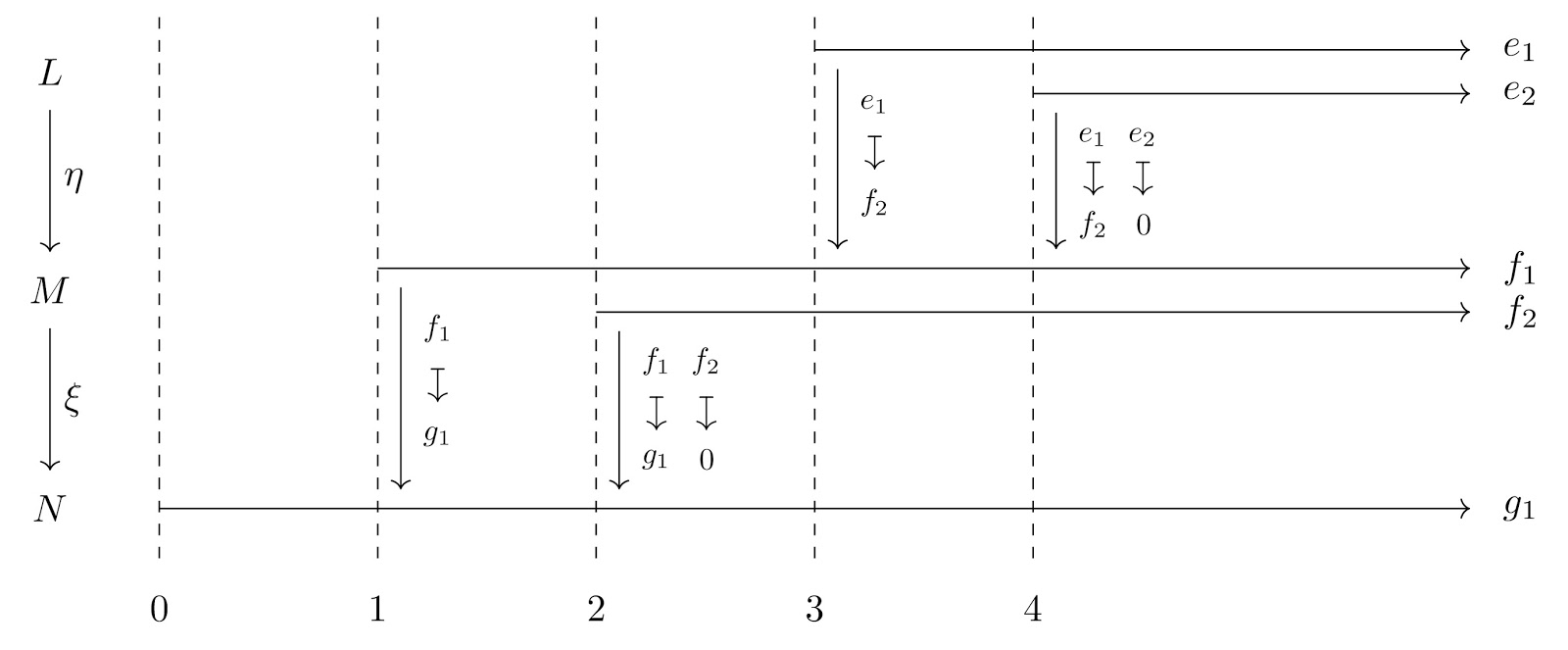
Example: Bauer and Lesnick present Example 5.6 to show that functoriality does not work in their setting. We reproduce their example and show that functoriality does work in our setting. Note that vertical ordering of the bars does not matter once they are named.
Apply the functor $\mathcal B$ to the whole diagram to get the matchings induced by $\eta$ and $\xi$, as below.
Next we hope to understand how interleavings fit into this setup.

References: Bauer and Lesnick (Induced matchings and the algebraic stability of persistence barcodes), Crawley-Boevey (Decomposition of pointwise finite-dimensional persistence modules)

Saturday, February 10, 2018

Artin gluing a sheaf 4: a single sheaf in two ways

The goal of this post is to give an alternative perspective on making a sheaf over $X = \Ran^{\leqslant n}(M)\times \R_{\geqslant 0}$, alternative to that of a previous post ("Artin gluing a sheaf 3: the Ran space," 2018-02-05). We will have one unique sheaf on all of $X$, valued either in simplicial complexes or simplicial sets.

Remark: Here we straddle the geometric category $SC$ of simplicial complexes and the algebraic category $\sSet$ of simplicial sets. There is a functor $[\ \cdot\ ]:SC\to \sSet$ for which every $n$-simplex in $S$ gets $(n+1)!$ elements in $[S]$, representing all the ways of ordering the vertices of $S$ (which we would like to view as unordered, to begin with).

Recall from previous posts:
  • maps $f:X\to SC$ and $g = [f]:X\to \sSet$,
  • the $SC_k$-stratification of $\Ran^k(M)\times \R_{\geqslant 0}$,
  • the point-counting stratification of $\Ran^{\leqslant n}(M)$,
  • the combined (via the product order) $SC_{\leqslant n}$-stratification of $\Ran^{\leqslant n}(M)\times \R_{\geqslant 0}$,
  • an induced (by the $SC_k$-stratification) cover by nested open sets $B_{k,1},\dots,B_{k,N_k}$ of $\Ran^k(M)\times \R_{\geqslant 0}$,
  • a corresponding induced total order $S_{k,1},\dots,S_{k,N_k}$ on $f(\Ran^k(M)\times \R_{\geqslant0})$.
The product order also induces a cover by nested opens of all of $X$ and a total order on $f(X)$ and $g(X)$. We call a path $\gamma:I\to X$ a descending path if $t_1<t_2\in I$ implies $h(\gamma(t_1))\geqslant h(\gamma(t_2))$ in any stratified space $h:X\to A$. Below, $h$ is either $f$ or $g$.

Lemma: A descending path $\gamma:I\to X$ induces a unique morphism $h(\gamma(0))\to h(\gamma(1))$.

Proof: Write $\gamma(0) = \{P_1,\dots,P_n\}$ and $\gamma(1) = \{Q_1,\dots,Q_m\}$, with $m\leqslant n$. Since the path is descending, points can only collide, not split. Hence $\gamma$ induces $n$ paths $\gamma_i:I\to M$ for $i=1,\dots,n$, with $\gamma_i$ the path based at $P_i$. This induces a map $h(\gamma(0))_0\to h(\gamma(1))_0$ on 0-cells (vertices or 0-objects), which completely defines a map $h(\gamma(0))\to h(\gamma(1))$ in the desired category. $\square$

Our sheaves will be defined using colimits. Fortunately, both $SC$ and $\sSet$ have (small) colimits. Finally, we also need an auxiliary function $\sigma:\Op(X)\to SC$ that finds the correct simplicial complex. Define it by \[ \sigma(U)  = \begin{cases}
S_{k,\ell} & \text{ if } U\neq\emptyset, \text{ for } k = \max\{1\leqslant k'\leqslant n\ :\ U\cap \Ran^k(M)\times \R_{\geqslant 0}\neq \emptyset\}, \\ & \hspace{2.23cm} \ell = \max\{1\leqslant \ell'\leqslant N_k\ :\ U \cap B_{k,\ell'}\neq\emptyset\},\\
* & \text{ if }U= \emptyset.
\end{cases} \]

Proposition 1: Let $\mathcal F$ be the function $\Op(X)^{op}\to SC$ on objects given by \[ \mathcal F(U) = \colim\left(\sigma(U)\rightrightarrows S\ :\ \text{every }\sigma(U)\to S \text{ is induced by a descending }\gamma:I\to U\right). \] This is a functor and satisfies the sheaf gluing conditions.

Proof: We have a well-defined function, so we have to describe the restriction maps and show gluing works. Since $V\subseteq U\subseteq X$, every $S$ in the directed system defining $\mathcal F(V)$ is contained in the directed system defining $\mathcal F(U)$. As there are maps $\sigma(V)\to \mathcal F(V)$ and $S\to \mathcal F(V)$, for every $S$ in the directed system of $V$, precomposing with any descending path we get maps $\sigma (U)\to \mathcal F(V)$ and $S\to \mathcal F(V)$, for every $S$ in the directed system of $U$. Then universality of the colimit gives us a unique map $\mathcal F(U)\to \mathcal F(V)$. Note that if there are no paths (decending or otherwise) from $U$ to $V$, then the colimit over an empty diagram still exists, it is just the initial object $\emptyset$ of $SC$.

To check the gluing condition, first note that every open $U\subseteq X$ must nontrivially intersect $\Ran^n(M)\times \R_{\geqslant 0}$, the top stratum (in the point-counting stratification). So for $W = U\cap V$, if we have $\alpha\in \mathcal F(U)$ and $\beta \in \mathcal F(V)$ such that $\alpha|_W = \beta|_W$ is a $k$-simplex, then $\alpha$ and $\beta$ must have been $k$-simplices as well. This is because a simplicial takes a simplex to a simplex, and we cannot collide points while remaining in the top stratum. Hence the pullback of $S\owns \alpha$ and $T\owns \beta$ via some induced maps (by descending paths) from $U$ to $W$ and $V$ to $W$, respectively, will restrict to the identity on the chosen $k$-simplex. Hence the gluing condition holds, and $\mathcal F$ is a sheaf. $\square$

Functoriality of $[\ \cdot\ ]$ allows us to extend the proof to build a sheaf valued in simplicial sets.

Proposition 2: Let $\mathcal G$ be the function $\Op(X)^{op}\to \sSet$ on objects given by \[ \mathcal G(U) = \colim\left([\sigma(U)]\rightrightarrows S\ :\ \text{every }[\sigma(U)]\to S \text{ is induced by a descending }\gamma:I\to U\right). \] This is a functor and satisfies the sheaf gluing conditions.

Remark: The sheaf $\mathcal G$ is non-trivial on more sets. For example, any path contained within one stratum of $X$ induces the identity map on simplicial sets (though not on simplicial complexes). Hence $\mathcal G$ is non-trivial on every open set contained within a single stratum.

References: nLab (article "Simplicial complexes"), n-category Cafe (post "Simplicial Sets vs. Simplicial Complexes," 2017-08-19)

Monday, February 5, 2018

Artin gluing a sheaf 3: the Ran space

The goal of this post is to extend earlier ideas, of a sheaf defined on $\Conf_n(M)\times \R_{\geqslant 0}$, to a family of sheaves defined on $\bigcup_{k=1}^n \Conf_n(M)\times \R_{\geqslant 0} = \Ran^{\leqslant n}(M)\times \R_{\geqslant 0}$.

Recall our main map $f:\Conf_n(M)\times \R_{\geqslant 0} \tov{VR(-)} SC_n \tov{\Hom(\Delta^\bullet,-)} \sSet$. Following Definition 1 and Proposition 2 in a previous post ("Artin gluing a sheaf 2: simplicial sets and configuration spaces," 2018-01-31), define a sheaf $\mathcal F_k$ on $X_k$ by \[ \mathcal F_k(U) = \begin{cases}
S_{k,\max\{1\leqslant \ell\leqslant N_k\ :\ U\cap B_{\ell}\neq \emptyset\}} & \text{ if $U$ is good,}\\
S_\emptyset & \text{ else if }U\neq\emptyset,
\end{cases} \hspace{2cm} (1) \] for all $k=1,\dots,n$. We have assumed a total order on all simplicial complexes on $k$ vertices, induced by a cover $U_k,\dots,U_{k,N_k}$ of nested opens of $X_k$. This induces a total order $S_{k,1},\dots,S_{k,N_k}$ on the image of $\Ran^k(M)\times \R_{\geqslant 0}$ in $\sSet$, and by the product order, a total order on all of $\sSet' := f(\Ran^{\leqslant n}(M)\times \R_{\geqslant 0})$.

A small example

Let $n=3$, so $X = \Ran^{\leqslant 3}(M)\times \R_{\geqslant 0}$. We already have $\mathcal F_1,\mathcal F_2,\mathcal F_3$ on $X_1,X_2,X_3$, respectively, and we will extend them from the top down to sheaves over all of $X$, as in the diagram below.
The map $i$ will be the inclusion of an open set into a larger one, and $j$ the inclusion of a closed set into a larger one. Recall that the pullback of two sheaves is defined equivalently by a map of sheaves on the boundary of the open nd closed sets. With that in mind, for $U\subseteq X_2\cup X_3$ good, the pullback square
defines $\mathcal F_{d_0}$, where the $d_0$ indicates the face map that skips the $0$th spot. The sheaf $\mathcal F_{d_1}$ is defined similarly, but by the face map $d_1$, and $\mathcal F_{d_2}$ by the face map $d_2$. For each of these three sheaves on $X_3\cup X_2$, we have two other sheaves, based on where the single point maps to. However, we note that for $U\subseteq X$ good and $U\cap X_1\neq\emptyset$, \[ \left((i_*\mathcal F_{d_0}\times j_*\mathcal F_1)(U) \text{ defined by } d_0\right)
\ \ =\ \
\left((i_*\mathcal F_{d_1}\times j_*\mathcal F_1)(U) \text{ defined by } d_0\right), \] where $\times$ denotes the pullback over the appropriate sheaf, and similarly for the other sheaves on good sets intersecting $X_1$. We now have 6 unique shaves on all of $X$.

Generalizing

Now let $n$ be any positive integer, and $X = \Ran^{\leqslant n}(M)\times \R_{\geqslant 0}$. We reverse the indexation of the $\mathcal F_k$ and $X_k$ above to make notation less cumbersome (so now $\mathcal F_k$ is $\mathcal F_{n-k+1}$ from (1), over $X_k = \Ran^{n-k+1}(M)\times \R_{\geqslant 0}$). Define pullback sheaves $\mathcal F_{d_{\ell_1}}$ for $\ell_1=0,\dots,n$ on $X_2\cup X_2$ by the diagram
At the $k$th step, for $1<k<n$, we have sheaves $\mathcal F_{d_{\ell_1}\cdots d_{\ell_{k-1}}}$ over $\bigcup_{m=1}^k X_m$, defined by sequences of face maps $d_{\ell_{k-1}}$ when going from $X_k$ to $X_{k-1}$ and so on, where $\ell_m\in \{0,\dots,n-m+1\}$. Define pullback sheaves $\mathcal F_{d_{\ell_1}\cdots d_{\ell_{k-1}}d_{\ell_k}}$, for $\ell_k = 0,\dots,n-k+1$ on $\bigcup_{m=1}^{k+1} X_k$ by the diagram
At the end of this inductive process, we have $n!$ distinct sheaves $\mathcal F_{d_{\ell_1}\cdots d_{\ell_{n-1}}}$ on all of $X$. Note there is a sheaf map $\mathcal F_{d_{\ell_1}\cdots d_{\ell_i}\cdots d_{\ell_{n-1}}} \to \mathcal F_{d_{\ell_1}\cdots d_{\ell_i'}\cdots d_{\ell_{n-1}}}$, given on $U$ good by \[ \mathcal F_{d_{\ell_1}\cdots d_{\ell_i}\cdots d_{\ell_{n-1}}}(U) = S \mapsto \begin{cases}
S & \text{ if } |S_0| \leqslant n-i, \\
(\ell_i\ \ell_i')(S) & \text{ else,}
\end{cases} \] where $(\ell_i\ \ell_i')\in \mathfrak S_n$ (the symmetric group on the numbers $0,\dots,n-1$) is the transposition swaps the $\ell_i$ and $\ell_i'$ indices of $S_0$, the 0-cells of $S$, inducing a map of simplicial sets. If the two sheaves differ in only two indices $\ell_i\neq \ell_i'$ and $\ell_j\neq \ell_j'$, with $i<j$, then we get $S\mapsto (\ell_j\ \ell_j')_{d_{\ell_{i-1}} \cdots d_{\ell_j}}(\ell_i\ \ell_i')(S)$. Here $(\ell_j\ \ell_j')_{d_{\ell_{i-1}} \cdots d_{\ell_j}}$ is the element of $\mathfrak S_{n-i}$ found by taking $(\ell_j\ \ell_j')$ from $\mathfrak S_{n-j}$ to $\mathfrak S_{n-i}$ by the sequence of group inclusion maps induced by the face maps $d_{\ell_j},\dots,d_{\ell_{i-1}}$.

Remark: This construction is not the most satisfying, for several reasons:
  • we do not have a single sheaf, rather a family of sheaves, and
  • the use of "good" sets leaves something to be desired, as we should be able to consider larger sets.
Both will hopefully be remedied in a later post.

Wednesday, January 31, 2018

Artin gluing a sheaf 2: simplicial sets and configuration spaces

The goal of this post is to extend the previous stratifying map to simplicial sets, and to generalize the sheaf construction to $X = \Conf_n(M)\times \R_{\geqslant 0}$ for arbitrary integers $n$, where $M$ is a smooth, compact, connected manifold. We work with $\Conf_n(M)$ instead of $\Ran^{\leqslant n}(M)$ because Lemma 1 and Proposition 2 have no chance of extending to $\Ran^{\leqslant n}(M)$ without major modifications (see Remark 3 at the end of this post).

Recall $SC$ is the category of simplicial complexes and simplicial maps, with $SC_n$ the full subcategory of simplicial complexes on $n$ vertices. Our main function is \[ \begin{array}{r c c c l}
f\ :\ X & \tov{f_1} & SC & \tov{f_2} & \sSet, \\
(P,a) & \mapsto & VR(P,a) & \mapsto & \Hom_{\Set}(\Delta^\bullet,VR(P,a)).
\end{array} \] On $\Conf_n(M)$ we have a natural metric, the Hausdorff distance $d_H(P,Q) = \max_{p\in P}\min_{q\in Q}d(p,q)+\max_{q\in Q}\min_{p\in P}d(p,q)$. This induces the 1-product metric on $X$, as \[ d_X((P,a),(Q,b)) = d_H(P,Q) + d(a,b), \] where $d$ without a subscript is Euclidean distance. We could have chosen any other $p$-product metric, but $p=1$ makes computations easier. For a given $(P,t)\in X$, write $P = \{P_1,\dots,P_n\}$ and define its maximal neighborhood to be the ball $B_X(\min\{\delta_1,\delta_2,t\},P)$, where \[ \delta_1 = \min_{i<j}\{d(P_i,P_j)\},
\hspace{1cm}
\delta_2 = \min_{i<j}\{|d(P_i,P_j)-t|\ :\ d(P_i,P_j)\neq t\}. \]

Lemma 1:
Any path $\gamma:I\to X$ induces a unique morphism $f(\gamma(0))\to f(\gamma(1))$ of simplicial sets.

Proof: Write $\gamma(0) = \{P_1,\dots,P_n\}$ and $\gamma(1) = \{Q_1,\dots,Q_n\}$. The map $\gamma$ induces $n$ paths $\gamma_i:I\to M$ for $i=1,\dots,n$, with $\gamma_i$ the path based at $P_i$. Let $s:\gamma(0)\to \gamma(1)$ be the map on simplicial complexes defined by $P_i\mapsto \gamma_i(1)$. Since we are in the configuration space, where points cannot collide (as opposed to the Ran space), this is a well-defined map. Then $f_2(s)$ is a morphism of simplicial complexes. $\square$

Note the morphism of simplicial sets induced by any path in a maximal neighborhood of $x\in X$ is the identity morphism. We now move to describing a sheaf over all of $X$.

Definition: Let $X$ be any topological space and $\mathcal C$ a category with pullbacks. Let $A\subseteq X$ open and $B=X\setminus A \subseteq X$ closed, with $i:A\hookrightarrow X$ and $j:B\hookrightarrow X$ the inclusion maps. Let $\mathcal F$ be a $\mathcal C$-valued sheaf on $A$ and $\mathcal G$ a $\mathcal C$-valued sheaf on $B$. Then the \emph{Artin gluing} of $\mathcal F$ and $\mathcal G$ is the $\mathcal C$-valued sheaf $\mathcal H$ on $X$ defined as the pullback, or fiber product, of $i_*\mathcal F$ and $j_*\mathcal G$ over $j_*j^*i_*\mathcal F$ in the diagram below.
Note the definition requires a choice of sheaf map $\varphi:\mathcal G\to j^*i_*\mathcal F$. In the proof below, this sheaf map will be the morphism of simplicial sets from Lemma 1 through the functor $\Hom_\Set(\Delta^\bullet,-) = f_2(-)$.

Recall the ordering of $SC_n$ described by the only definition in a previous post ("Exit paths, part 2," 2017-09-28). Fix a cover $\{A_i\}_{i=1}^{N}$ of $SC_n$ by nested open subsets (so $N=|SC_n|$), with $B_i := f_1^{-1}(A_i)$ and $B_{\leqslant i} := \bigcup_{j=1}^i B_i$. We now have an induced order on and cover of $\im(f)=\sSet'$, as a full subcategory of $\sSet$. Even more, we now have an induced total order on $\sSet' = \{S_1,\dots,S_N\}$, with $S_i$ the unique simplicial set in $A_i\setminus A_{i-1}$. For example, $S_1=\Hom_\Set(\Delta^\bullet,\Delta^n)$ and $S_{N}=\Hom_\Set(\Delta^\bullet,\bigcup_{i=1}^n\Delta^0)$.

For ease of notation, we let $B_0 = \emptyset$ and write $S_\emptyset = \Hom(\Delta^\bullet,\emptyset)$, $S_0 = \Hom(\Delta^\bullet,\Delta^0)$.

Definition 1: Let $\mathcal F_i:\Op(B_i)^{op}\to \sSet$ be the locally constant sheaf given by $\mathcal F_i(U_x) = S_i$, where $U_x$ is a subset of the maximal neighborhood of $x\in B_i$. In general, \[ \mathcal F_i(U) = \begin{cases}
S_i & \text{ if }\begin{array}[t]{l}U\neq \emptyset, \\U\text{ is path connected},\\\text{every loop }\gamma:I\to U\text{ induces }\id:f(\gamma(0))\to f(\gamma(1)),\end{array} \\
S_\emptyset & \text{ else if }U\neq\emptyset, \\
S_0 & \text{ else.}
\end{cases} \] In general, we say $U\subseteq X$ is good if it is non-empty, path connected, and every loop $\gamma:I\to U$ induces the identity morphism on simplicial sets.

Proposition 2: Let $\mathcal F_{\leqslant 1} = \mathcal F_1$, and $\mathcal F_{\leqslant i}$ be the sheaf on $B_{\leqslant i}$ obtained by Artin gluing $\mathcal F_i$ onto $\mathcal F_{\leqslant i-1}$, for all $i=2,\dots,N$. Then $\mathcal F = \mathcal F_{\leqslant N}$ is the $SC_n$-constructible sheaf on $X$ described by \[ \mathcal F(U) = \begin{cases}
S_{\max\{1\leqslant \ell\leqslant N\ :\ U\cap B_{\ell}\neq \emptyset\}} & \text{ if $U$ is good,}\\
S_\emptyset & \text{ else if }U\neq\emptyset, \\
S_0 & \text{ else.}
\end{cases} \hspace{2cm} (1) \]

Proof: We proceed by induction. Begin with the constant sheaf $\mathcal F_1$ on $B_1$ and $\mathcal F_2$ on $B_2$, which we would like to glue together to get a sheaf $\mathcal F_{\leqslant2}$ on $B_{\leqslant 2}$. Since $f_1$ is continuous in the Alexandrov topology on the poset $SC_{\leqslant n}$, $B_1\subseteq B_{\leqslant 2}$ is open and $B_2 \subseteq B_{\leqslant 2}$ is closed. Let $i:B_1\hookrightarrow B_{\leqslant 2}$ and $j:B_2\hookrightarrow B_{\leqslant 2}$ be the inclusion maps. The sheaf $j^*i_*\mathcal F_1$ has support $\closure(B_1)\cap B_2 \neq \emptyset$ with \[ j^*i_*\mathcal F_1(U) = \colim_{V\supseteq j(U)}\left[i_*\mathcal F_1(V)\right] = \colim_{V\supseteq U}\left[\mathcal F_1(V\cap B_1)\right] = \begin{cases}
S_1 & \text{ if }U\cap \closure(B_1)\text{ is good}, \\ S_\emptyset & \text{ else},
\end{cases} \] for any non-empty $U\subseteq B_2$. Let the sheaf map $\varphi:\mathcal F_2\to j^*i_*\mathcal F_1$ be the inclusion simplicial set morphism on good sets (it can be thought of as induced through Lemma 1 by a path starting in $U\cap B_2$ and ending in $V\cap B_1$, for $V$ a small enough set in the colimit above). Note that $S_2 = \Hom_\Set(\Delta^\bullet,\Delta^n\setminus \Delta^1)$, where $\Delta^n\setminus \Delta^1$ is the simplicial complex resulting from removing an edge from the complete simplicial complex on $n$ vertices. Let $\mathcal F_{\leqslant 2}$ be the pullback of $i_*\mathcal F_1$ and $j_*\mathcal F_2$ along $j_*j^*i_*\mathcal F_1$, and $U\subseteq B_{\leqslant 2}$ a good set. If $U\subseteq B_1$, then $\mathcal F_{\leqslant 2}(U) = \mathcal F_1(U)=S_1$, and if  $U\subseteq B_2$, then $\mathcal F_{\leqslant 2}(U) = \mathcal F_2(U) = S_2$. Now suppose that $U\cap B_1 \neq \emptyset$ but also $U\cap B_2\neq\emptyset$, which, since $U$ is good, implies that $U\cap \closure(B_1)\cap B_2\neq\emptyset$. Then we have the pullback square
If $U$ is not good, then the simplicial sets are $S_\emptyset$ or $S_0$, with nothing interesting going on. The pullback over a good set $U$ can be computed levelwise as \[ \mathcal F_{\leqslant 2}(U)_m = \{(\alpha,\beta)\in (S_1)_m\times (S_2)_m\ :\ \alpha=j_*\varphi(\beta)\}. \hspace{2cm} (2)\] Since $j_*\varphi$ is induced by the inclusion $\varphi$, it is the identity on its image. So $\alpha = j_*\varphi(\beta)$ means $\alpha=\beta$, or in other words, $\mathcal F_{\leqslant 2}(U)=S_2$. Hence for arbitrary $U\subseteq B_{\leqslant 2}$, we have \[ \mathcal F_{\leqslant 2}(U) = \begin{cases}
S_{\max\{\ell=1,2\ :\ U\cap B_{\ell}\neq \emptyset\}} & \text{ if $U$ is good,}\\
S_\emptyset & \text{ else if }U\neq\emptyset, \\
S_0 & \text{ else.}
\end{cases}\]

For the inductive step with $k>1$, let $\mathcal F_{\leqslant k}$ be the sheaf on $B_{\leqslant k}$ defined as in Equation (1), but with $k$ instead of $N$. We would like to glue $\mathcal F_{\leqslant k}$ to $\mathcal F_{k+1}$ on $B_{k+1}$ to get a sheaf $\mathcal F_{\leqslant k+1}$ on $B_{\leqslant k+1}$. As before, $B_k \subseteq B_{\leqslant k+1}$ is open and $B_{k+1}\subseteq B_{\leqslant k+1}$ is closed. For $i:B_k\hookrightarrow B_{\leqslant k+1}$ and $j:B_{k+1}\hookrightarrow B_{\leqslant k+1}$ the inclusion maps, the sheaf $j^*i_*\mathcal F_{\leqslant k}$ has support $\closure(B_{\leqslant k})\cap B_{k+1}$, with \[ j^*i_*\mathcal F_{\leqslant k}(U) = \colim_{V\supseteq j(U)}\left[i_*\mathcal F_{\leqslant k}(V)\right] = \colim_{V\supseteq U}\left[\mathcal F_{\leqslant k}(V\cap B_{\leqslant k})\right] = \begin{cases} S_{\max\{1\leqslant \ell\leqslant k\ :\ U\cap \closure(B_\ell)\neq\emptyset\}} & \text{ if }U\cap \closure(B_{\leqslant k})\text{ is good,} \\ S_\emptyset & \text{ else,} \end{cases} \] for any non-empty $U\subseteq B_{k+1}$. Let the sheaf map $\varphi:\mathcal F_{k+1}\to j^*i_*\mathcal F_{\leqslant k}$ be the inclusion simplicial set morphism on good sets (it can be thought of as induced through Lemma 1 by a path starting in $U\cap B_{k+1}$ and ending in $V\cap B_{\leqslant k}$, for $V$ a small enough set in the colimit above). For $U\subseteq B_{\leqslant k+1}$ a good set, if $U\subseteq B_{\leqslant k}$, then $\mathcal F_{\leqslant k+1}(U) = \mathcal F_{\leqslant k}(U)$, and if  $U\subseteq B_{k+1}$, then $\mathcal F_{\leqslant k+1}(U) = \mathcal F_{k+1}(U) = S_{k+1}$. Now suppose that $U\cap B_{\leqslant k} \neq \emptyset$ but also $U\cap B_{k+1}\neq\emptyset$, which, since $U$ is good, implies that $U\cap \closure(B_{\leqslant k})\cap B_{k+1}\neq\emptyset$. Then we have the pullback square
If $U$ is not good, then the simplicial sets are $S_\emptyset$ or $S_0$, with nothing interesting going on. Again, as in Equation (2), the pullback $\mathcal F_{\leqslant k+1}$ on a good set $U$ is \[ \mathcal F_{\leqslant k+1}(U)_m = \{(\alpha,\beta)\in (S_\ell)_m\times (S_{k+1})_m\ :\ \alpha = j_*\varphi(\beta)\}, \] and as before, this implies that $\mathcal F_{\leqslant k+1}(U) = S_{k+1}$. Hence $\mathcal F_{\leqslant k+1}$ is exactly of the form as in Equation (1), with $k+1$ instead of $N$, and by induction we get the desired description for $\mathcal F_{\leqslant N}= \mathcal F$.  $\square$

Remark 3: The statements given in this post do not extend to $\Ran^{\leqslant n}(M)$, at least not as stated. Lemma 1 fails if  somewhere along the path $\gamma$ a point splits in two or more points, as there is no canonical choice which of the "new" points should be the image of the "old" point. This means that the proof of Proposition 2 will also fail, because we relied on a uniquely defined sheaf map $\varphi$ between strata.

Next, we hope to use this approach to describe classic persistent homology results, and maybe link this to the concept of persistence modules.

References: Milne (Etale cohomology, Chapter 2.3)

Sunday, January 21, 2018

Artin gluing a sheaf 1: a small example

The goal of this post is to describe a sheaf on a particular stratified space using locally constant sheaves defined on the strata. Thanks to Joe Berner for helpful discussions.

Recall the direct image and inverse image sheaves from a previous post ("Sheaves, derived and perverse," 2017-12-05). Let $M$ be a smooth, compact, connected manifold, and $X = \Ran^{\leqslant 2}(M)\times \R_{\geqslant 0}$. Let $SC$ be the category of abstract simplicial complexes and simplicial maps. All sheaves will be functors $\text{Op}(-)^{op}\to SC$. The space $X$ looks like the diagram below.


Let $Y = A\cup B$. Note that $A\subseteq Y$ is open, $B\subseteq Y$ is closed, $Y\subseteq X$ is open, and $C\subseteq X$ is closed. There is a natural stratified map $f:X\to \{1,2,3\}$, with $\{1,2,3\}$ given the natural ordering. The map $f$ is described by $f^{-1}(3) = A$, $f^{-1}(2) = B$, and $f^{-1}(1) = C$. Define the inclusion maps \begin{align*}
i\ &:\ A \hookrightarrow Y, & k\ &:\ Y\hookrightarrow X,\\
j\ &:\ B \hookrightarrow Y, & \ell\ &:\ C\hookrightarrow X.
\end{align*} Define the following constant sheaves on $A,B,C$, respectively:
If $U = \emptyset$, all three give back the simplicial complex on a single vertex. We will now attempt to define a sheaf on all of $X$ by gluing sheaves on the strata. Choose some subsets of $X$ as below on which to test the sheaves.

Step 1: Extend $\mathcal F$ and $\mathcal G$ to a sheaf on $Y$.

The direct image of $\mathcal F$ via $i$, as a sheaf on $Y$, is
for any $U\subseteq Y$. The inverse image of $i_*\mathcal F$ via $j$, as a sheaf on $B$, is
for any $U\subseteq B$. Note $j^*i_*\mathcal F(B')$ is the 0-simplex and $j^*i_*\mathcal F(B'')$ is the 1-simplex. The inverse image sheaf is actually defined as the sheafification of the presheaf obtained by taking the colimit, but the sheaf axioms are easily seen to be satisfied here, as the support is on a closed subset.

Following the MathOverflow question, we need to define a map $\mathcal G \to j^*i_*\mathcal F$ of sheaves on $B$. Since the support of $j^*i_*\mathcal F$ is only $\text{cl}(A)\cap B$, it suffices to define the map here, and we can do it on stalks. There is a natural simplicial map
which we use as the sheaf map. It seems we should now have a sheaf on all of $Y$ now, but the result is not immediate. Following the proof of Theorem 3.10 in Chapter 2 of Milne, we need to take the fiber product, or pullback, of $i_*\mathcal F$ and $j_*\mathcal G$ over $j_*j^*i_*\mathcal F$, call it $\mathcal K$. Consider the pullback diagram on sets like $B'''$:
Hence it makes sense that $\mathcal K(B''')$ is two 0-simplicies. We now have a sheaf $\mathcal K$ on $Y$ given by

Step 2: Extend $\mathcal K$ and $\mathcal H$ to a sheaf on $X$.

The direct image of $\mathcal K$ via $k$, as  a sheaf on $X$, is
for any $U\subseteq X$. The inverse image of $k_*\mathcal K$ via $\ell$, as a sheaf on $C$, is
for any $U\subseteq C$. We need to again define a map $\mathcal H\to \ell^*k_*\mathcal K$ of sheaves on $C$. On stalks we naturally have maps
due to the fact that both complexes are symmetric, so sending to one or the other vertex is the same. Let $\mathcal L$ be the sheaf we should now have defined over all of $X$, by taking the fiber product of $\ell_*\mathcal H$ and $k_*\mathcal K$ over $\ell_*\ell^*k_*\mathcal K$. Let us consider its pullback diagrams for the sets $L',M',N'$.
It seems that we should set $\mathcal L(L') = \mathcal L(M') = \mathcal L(N')$ to be the 0-simplex. We now have a sheaf $\mathcal L$ on $X$ given by
The next goal is to extend this approach to $\Ran^{\leqslant n}(M)\times \R_{\geqslant 0}$. An immediate difficulty seems to be finding canonical simplicial maps like $\varphi$ and $\psi$, but hopefully a choice of increasing nested open cover of the startifying set of $X$ will solve this problem.

References: MathOverflow (Question 54037), Milne (Etale cohomology, Chapter 2.3)

Tuesday, December 19, 2017

A naive constructible sheaf

In this post we describe a constructible sheaf over $X=\Ran^{\leqslant n}(M)\times \R_{>0}$ valued in simplicial complexes, for a compact, smooth, connected manifold $M$. We note however that it does not capture all the information about the underlying space. Thanks to Joe Berner for helpful ideas.

Recall the category $SC$ of simplicial complexes and simplicial maps, as well as the full subcategories $SC_n$ of simplicial complexes with $n$ vertices (the vertices are unordered). Let $A = \bigcup_{k=1}^n SC_n$ with the ordering $\leqslant_A$ as in a previous post ("Ordering simplicial complexes with unlabeled vertices," 2017-12-03), and $f:X\to A$ the stratifying map. Let $\{A_k\}_{k=1}^N$ be a cover of $X$ by nested open sets of the type $f^{-1}(U_S) = f^{-1}(\{T\in A\ :\ S\leqslant_A T\})$, whose existence is guaranteed as $A$ is finite. Note that $f(A_1)$ is a singleton containg the complete simplex on $n$ vertices.

Remark: For every simplicial complex $S\in A$, there is a locally constant sheaf over $f^{-1}(S)\subseteq X$. Given the cover $\{A_k\}$ of $X$, denote this sheaf by $\mathcal F_k \in \Shv(A_k\setminus A_{k-1})$ and its value by $S_k\in SC$.

Let $i^1:A_1\hookrightarrow A_2$ and $j^2:A_2\setminus A_1 \hookrightarrow A_2$ be the natural inclusion maps . Note that $A_1$ is open and $A_2\setminus A_1$ is closed in $A_2$. The maps $i^1,j^2$ induce direct image functors on the sheaf categories\[i^1_*:\Shv(A_1) \to \Shv(A_2),
\hspace{1cm}
j^2_*:\Shv(A_2\setminus A_1) \to \Shv(A_2).\]The induced sheaves in $\Shv(A_2)$ are extended by 0 on the complement of the domain from where they come. Note that since $A_2\setminus A_1\subseteq A_2$ is closed, $j^2_*$ is the same as $j^2_!$, the direct image with compact support. We then have the direct sum sheaf $i^1_*\mathcal F_1 \oplus j_*^2\mathcal F_2 \in \Shv(A_2)$, which we interpret as the disjoint union in $SC$. Then\[\left(i_*^1\mathcal F_1 \oplus j_2^*\mathcal F_2\right)(U) = \begin{cases}
S_1 & \text{ if }U\subseteq A_1, \\
S_2 & \text{ if }U\subseteq A_2\setminus A_1, \\
S_1\sqcup S_2 & \text{ else,}
\end{cases}
\hspace{1cm}
\left(i_*^1\mathcal F_1 \oplus j_2^*\mathcal F_2\right)_{(P,t)} = \begin{cases}
S_1 & \text{ if } (P,t)\in A_1, \\
S_2 & \text{ if }(P,t)\in \text{int}(A_2\setminus A_1), \\
S_1\sqcup S_2 & \text{ else,}
\end{cases}\]for $U\subseteq A_2$ open and $(P,t)\in A_2$. Generalizing this process, we get a sheaf on $X$. The diagram

may be helpful to keep in mind. We use the fact that direct sums commute with colimits (used in the definition of the direct image sheaf) to simplify notation. We then get sheaves\[\begin{array}{r c l}
\mathcal F^1 & \in & \Shv(A_1), \\
i_*^1\mathcal F^1 \oplus j_*^2 \mathcal F^2 & \in & \Shv(A_2), \\
i_*^2i_*^1\mathcal F^1 \oplus i_*^2j_*^2 \mathcal F^2 \oplus j_*^3 \mathcal F^3 & \in & \Shv(A_3), \\
i_*^3i_*^2i_*^1\mathcal F^1 \oplus i_*^3i_*^2j_*^2 \mathcal F^2 \oplus i_*^3j_*^3 \mathcal F^3 \oplus j_*^4 \mathcal F^4 & \in & \Shv(A_4),
\end{array}\]and finally\[i_*^{N-1\cdots 1}\mathcal F^1 \oplus \left(\bigoplus_{k=2}^{N-1} i_*^{N-1\cdots k}j_*^k \mathcal F^k \right) \oplus j_*^N \mathcal F^N \in \Shv(A_N=X),\]where $i_*^{N-1\cdots k}$ is the composition $i_*^{N-1} \circ i_*^{N-2} \circ \cdots \circ i_*^k$ of direct image functors. Call this last sheaf simply $\mathcal F \in \Shv(X)$. Each $i_*^k$ extends the sheaf by 0 on an ever larger domain, so every summand in $\mathcal F$ is non-zero on exactly one stratum as defined by $f:X\to A$. We now have a functor $\mathcal F:Op(X) \to SC$ defined by\[\mathcal F(U) = \bigsqcup_{k=1}^N S_k \delta_{U,A_K\setminus A_{k-1}},
\hspace{1cm}
\mathcal F_{(P,t)} = \bigsqcup_{k=1}^N S_k \delta_{(P,t),\text{cl}(,A_K\setminus A_{k-1})},\]where $\delta_{U,V}$ is the Kronecker delta that evaluates to the identity if $U\cap V \neq \emptyset$ and zero otherwise.

Remark: The sheaf $\mathcal F$ is $A$-constructible, as $\mathcal F|_{f^{-1}(S)}$ is a constant sheaf evaluating to the simplicial complex $S\in A$. However, if we want the cohomology groups to capture how the simplicial complexes change between strata, then we must use a different approach - all groups die when leaving a stratum because of the extension by zero construction.

References: nLab (article "Simplicial complexes")