Sunday, April 22, 2018

A functor from entry paths to the nerve of simplicial complexes

Fix $n\in \Z_{>0}$ and let $X=\Ran^{\leqslant n}(M)\times \R_{>0}$ for $M$ a compact, connected PL manifold embedded in $\R^N$. Take $\widetilde h\colon X\to (B,\leqslant)$ the conical stratifying map from a previous post (``Conical stratifications via semialgebraic sets," 2018-04-16) compatible with the natural stratification $h\colon X\to SC$. The goal of this post is to construct a functor $F\colon \Sing_B(X) \to N(SC)$ from the $\infty$-category of entry paths that encodes the structure of $X$.

Recall that a simplicial set is a functor, an element of $\text{Fun}(\Delta^{op},\Set)$. A simplicial set $S$ is defined by its collection of $n$-simplices $S_n$, its face maps $s_i:S_{n-1}\to S_n$, and degeneracy maps $d_i:S_{n+1}\to S_k$, for all $i=0,\dots,n$. For the first simplicial set of interest in this post, we have
\begin{align*}
\Sing_B(X)_n & = \Hom_{\Top}^B(|\Delta^n|,X), \\
\left(s_i\colon [n]\to [n-1]\right) & \mapsto \left( \begin{array}{c}
\left(|\Delta^{n-1}|\to X \right) \mapsto \left(|\Delta^n|\to X\right) \\
\text{collapses $i$th with $(i+1)$th vertex, then maps as source}
\end{array}\right)\\
\left(d_i\colon [n]\to [n+1]\right) & \mapsto  \left(\begin{array}{c}
\left(|\Delta^{n+1}|\to X \right) \mapsto \left(|\Delta^n|\to X\right) \\
\text{maps as $i$th face of source map}
\end{array}\right)
\end{align*}
We write $\Hom^B_{\Top}$ for the subset of $\Hom_{\Top}$ that respects the stratification $B$ in the context of entry paths. For the second simplicial set, the nerve, we have
\begin{align*}
N(SC)_n & = \{(S_0\tov{f_1} \cdots \tov{f_n} S_n)\ :\ S_i\in SC,\ f_i\ \text{are simplicial maps}\}, \\
\left(s_i\colon [n]\to [n-1]\right) & \mapsto \left( \left(S_0\tov{f_1}\cdots \tov{f_{n-1}} S_{n-1} \right) \mapsto \left(S_0\tov{f_1} \cdots\tov{f_i} S_i \tov{\id} S_i\tov{f_{i+1}} \cdots \tov{f_{n-1}} S_{n-1}\right)\right),\\
\left(d_i\colon [n]\to [n+1]\right) & \mapsto \left(\begin{array}{r l}
i=0: & \left(S_0\cdots S_{n+1} \right) \mapsto \left(S_1\tov{f_2}\cdots \tov{f_{n+1}} S_{n+1} \right) \\
0<i<n: & \left(S_0 \cdots S_{n+1} \right) \mapsto \left(S_0\tov{f_1} \cdots\tov{f_{i-1}} S_{i-1} \tov{f_{i+1}\circ f_i} S_{i+1} \tov{f_{i+2}} \cdots \tov{f_{n+1}} S_{n+1}\right) \\
i=n: & \left(S_0 \cdots  S_{n+1} \right) \mapsto \left(S_0\tov{f_1}\cdots \tov{f_n} S_n \right)
\end{array} \right). 
\end{align*}
 Define $F$ on $k$-simplices as \[ F\left(\gamma\colon |\Delta^k|\to \Ran^{\leqslant n}(M)\times \R_{>0}\right) = \left(\widetilde h(\gamma(1,0,\dots,0)) \tov{\left(\widetilde h\circ \gamma \circ s_k\circ \cdots \circ s_2\right)\left( |\Delta^1|\right)} \cdots \tov{\left(\widetilde h\circ \gamma \circ s_{k-2}\circ \cdots \circ s_0\right)\left(|\Delta^1|\right)} \widetilde h(\gamma(0,\dots,0,1))\right). \] A morphism in $\Sing_B(X)$ is a composition of face maps $s_i$ and degeneracy maps $d_i$, so $F$ must satisfy the commutative diagrams

for all $s_i$, $d_i$. Since the maps are unwieldy when in coordinates, we opt for heuristic arguments, neglecting to trace out notation-heavy diagrams.

Commutativity of the diagram on the left is immediate, as considering a simplex $|\Delta^{n-1}|$ as the $i$th face of a larger simplex $|\Delta^n|$ is the same as adding a step that is the identity map in the Hamiltonian path of vertices of $|\Delta^{n-1}|$. Similarly, observing that the image of the shortest path $v_{i-1}\to v_i\to v_{i+1}$ in $|\Delta^{n+1}|$, for $v_i = (0,\dots,0,1,0,\dots,0)$ the $i$th standard basis vector, induced by an element $\gamma\colon |\Delta^{n+1}|\to X$ in $\Sing_B(X)_{n+1}$, is homotopic to the image of the shortest path $v_{i-1} \to v_{i+1}$ shows that the diagram on the right commutes. Since $F$ is a natural transformation between the two functors $\Sing_B(X)$ and $N(SC)$, it is a functor on the functors as simplicial sets.

Remark: The particular choice of $X$ did not seem to play a large role in the arguments above. However, the stratifying map $\widetilde h\colon X\to B$ has image sitting inside $SC$, the nerve of which is the target of $F$, and every morphism in $\Sing_B(X)$ can be interpreted as a relation in $B\subseteq SC$ (both were necessary for the commutativity of the diagrams). Hence it is not unreasonable to expect a similar functor $\Sing_A(X)\to N(A')$ may exist for a stratified space $X\to A\subseteq A'$.

Friday, April 20, 2018

Exit paths and entry paths through $\infty$-categories

Let $X$ be a topological space, $(A,\leqslant)$ a poset, and $f: X\to (A,\leqslant)$ a continuous map.

Definition: An exit path in an $A$-stratified space $X$ is a continuous map $\sigma: |\Delta^n|\to X$ for which there exists a chain $a_0\leqslant \cdots \leqslant a_n$ in $A$ such that $f(\sigma(t_0,\dots,t_i,0,\dots,0))=a_i$ for $t_i\neq 0$. An entry path is a continuous map $\tau: |\Delta^n|\to X$ for which there exists a chain $b_0\leqslant \cdots \leqslant b_n$ in $A$ such that $f(\tau(0,\dots,0,t_i,\dots,t_n))=b_i$ for $t_i\neq 0$.

Up to reordering of vertices of $\Delta^n$ and induced reordering of the realization $|\Delta^n|$, an exit path is the same as an entry path. The next example describes this equivalence.

Example: The standard 2-simplex $|\Delta^2|$ is uniquely an exit path and an entry path with a chain of 3 distinct elements, stratfied in the ways described below.
Recall the following algebraic constructions, through Joyal's quasi-category model:
  • A simplicial set is a functor $\Delta^{op}\to \Set$.
  • A Kan complex is a simplicial set satisfying the inner horn condition for all $0\leqslant k\leqslant n$. That is, the $k$th $n$-horn lifts (can be filled in) to a map on $\Delta^n$.
  • An $\infty$-category is a simplicial set satisfying the inner horn condition for all $0<k<n$.
Moreover, if the lift is unique, then the Kan complex is the nerve of some category. Recall also the category $\Sing(X) = \{$continuous $\sigma: |\Delta^n|\to X\}$, which can be combined with the stratification $f: X\to A$ of $X$

Remark: The subcategory $\Sing^A(X)$ of exit paths and the subcategory $\Sing_A(X)$ of entry paths are full subcategories of $\Sing(X)$, with $(\Sing^A(X))^{op} = \Sing_A(X)$. If the stratification is conical, then these two categories are $\infty$-categories.
Recall the nerve construction of a category. Here we are interested in the nerve of the category $SC$ of simplicial complexes, so $N(SC)_n = \{$sequences of $n$ composable simplicial maps$\}$. Recall the $k$th $n$-horns, which are compatible diagrams of elements of $N(SC)_n$. In general, they are colimits of a diagram in the category $\Delta$. That is, \[ \Lambda^n_k := \colim \left(\bigsqcup_{0\leqslant i<j\leqslant n} \Delta^{n-2} \rightrightarrows \bigsqcup_{0\leqslant i\leqslant n \atop i\neq k} \Delta^{n-1}\right). \] Example: The images of the 3 different types of 2-horns and 4 different types of 3-horns in $SC$ are given below. Note that they are not unique, and depend on the choice of simplices $S_i$ (equivalently, on the choice of functor $\Delta^{op}\to SC$).
For example, the 0th 2-horn $\Lambda^2_0$ can be filled in if there exists a simplicial map $h: S_1\to S_2$ in $SC$ (that is, an element of $N(SC)_1$) such that $h\circ f = g$. Similarly, the 1st 3-horn $\Lambda^3_1$ can be filled in if there exists a functor $F: [0<1<2]\to SC$ for which $F(0<1)=f_{02}$, $F(0<2)=f_{03}$, and $F(1<2)=f_{23}$ (equivalently, a compatible collection of elements of $N(SC)_2$).

Definition: Let $A,B$ be $\infty$-categories. A functor $F: A\to B$ is a morphism of the simplicial sets $A,B$. That is, $F:A\to B$ is a natural transformation for $A,B\in \text{Fun}(\Delta^{op},\Set)$.

A functor of simplicial sets of a particular type can be identified with a functor of 1-categories. Recall the nerve of a 1-category, which turns it into an $\infty$-category. This construction has a left adjoint.

Definition: Let $\mathcal C$ be an $\infty$-category. The homotopy category $h\mathcal C$ of $\mathcal C$ has objects $\mathcal C_0$ and morphisms $\Hom_{h\mathcal C}(X,Y) = \pi_0(\text{Map}_{\mathcal C}(X,Y))$.

By Lurie, $h$ is left-adjoint to $N$. That is, $h : \sSet \rightleftarrows \text{Cat} : N$, or $\text{Map}_{\sSet}(\mathcal C,N(\mathcal D)) \cong \text{Map}_{\text{Cat}}(h\mathcal C, \mathcal D)$, for any $\infty$-category $\mathcal C$ and any 1-category $\mathcal D$. Our next goal is to describe a functor $\Sing_A(X)\to N(SC)$, maybe through this adjunction, where $SC$ is the 1-category of simplicial complexes and simplicial maps.

References: Lurie (Higher topos theory, Sections 1.1.3 and 1.2.3), Lurie (Higher algebra, Appendix A.6), Goerss and Jardine (Simplicial homotopy theory, Section I.3), Joyal (Quasi-categories and Kan complexes)

Monday, April 16, 2018

Conical stratifications via semialgebraic sets

The goal of this post is to describe a conical stratification of $\Ran_{\leqslant n}(M)\times \R_{\geqslant 0}$ that refines the stratification previously seen (in "Exit paths, part 2," 2017-09-28, and "Refining stratifiations," 2018-03-11). Thanks to Shmuel Weinberger for the key observation that the strata under consideration are nothing more than semialgebraic sets, which are triangulable, and so admit a conical stratification via this triangulation.

Remark: Fix $n\in \Z_{>0}$, let $M$ be a smooth, compact, connected, embedded submanifold in $\R^N$, and let $M^n$ have the Hausdorff topology. We will be interested in $M^n\times \R_{>0}$, though this will be viewed as the compact set $M^n\times [0,K]\subseteq \R^{nN+1}$ for some $K$ large enough (for instance, larger than the diameter of $M$) when necessary. The point 0 is added for compactness.

Stratification of the Ran space by semialgebraic sets


We begin by stratifying $M^n\times \R_{>0}$ by a poset $A$, creating strata based on the pairwise distance between points in each $M$ component. Then we take that to a stratification of the quotient $\Ran^{\leqslant n}(M)\times \R_{>0}$ via the action of the symmetric group $S_n$ and overcounting of points.

Definition: Define a partial order $\leqslant$ on the set $A = \big\{$partitions of ($\{1,\dots,n\}^2\setminus \Delta)/S_2$ into 4 parts$\big\}$ of ordered 4-tuples of sets by \[ (Q,R,S,T) \leqslant \left(Q\setminus Q',\ R\cup Q' \cup S',\ S\setminus (S'\cup S''),\ T\cup S''\right), \] for all $Q'\subseteq Q$ and $S',S''\subseteq S$, with $S'\cap S'' = \emptyset$.

The diagram to keep in mind is the one below, with arrows pointing from lower-ordered elements to higher-ordered elements. Once we pass to valuing the 4-tuple in simplicial complexes, moving between $Q$ and $R$ will not change the simplicial complex type (this comes from the definition of the Vietoris--Rips complex).

Lemma 1: The map $f: M^n\times \R_{>0}\to (A,\leqslant)$ defined by \begin{align*} (\{P_1,\dots,P_n\},t)\mapsto \bigg( \{(i,j>i)\ & :\ P_i=P_j\},\ \{(i,j>i)\ :\ d_M(P_i,P_j)<t\},\\
& \{(i,j>i)\ :\ d_M(P_i,P_j)=t\},\ \{(i,j>i)\ :\ d_M(P_i,P_j)>t\}\bigg) \end{align*} is continuous in the upset topology on $(A,\leqslant)$.

Proof: Choose $(Q,R,S,T)\in A$ and consider the open set $U = U_{(Q,R,S,T)}$ based at $(Q,R,S,T)$. Take $(P,t)\in f^{-1}(U)$, which we claim has a small neighborhood still contained within $f^{-1}(U)$. If we move a point $P_i$ slightly that was exactly distance $t$ away from $P_j$, then the pair $(i,j)$ was in $S$, but is now in either $R$ or $T$, and both $(Q,R\cup\{(i,j)\},S\setminus \{(i,j)\},T)$ and $(Q,R,S\setminus \{(i,j)\},T\cup \{(i,j)\})$ are ordered higher than $(Q,R,S,T)$, so the perturbed point is still in $f^{-1}(U)$. If $P_i=P_j$ in $P$ and we move them apart slightly, since $t\in \R_{>0}$, the pair $(i,j)$ will move from $Q$ to $R$, and $(Q,R,S,T) \leqslant (Q\setminus \{(i,j)\},R\cup \{(i,j)\},S,T)$, so the perturbed point is still in $f^{-1}(U)$. For all pairs $(i,j)$ in $R$ or $T$, the distances can be changed slightly so that the pair still stays in $R$ or $T$, respectively. Hence $f$ is continuous. $\square$

This shows that $M^n\times \R_{>0}$ is stratified by $(A,\leqslant)$, using Lurie's definition of a (poset) stratification, which just needs a continuous map to a poset. Our goal is to work with the Ran space of $M$, instead of the $n$-fold product of $M$, which are related by the natural projection map $\pi : M^n\to \Ran^{\leqslant n}(M)$, taking $P=\{P_1,\dots,P_n\}$ to the unordered set of distinct elements in $P$. We also would like to stratify $\Ran^{\leqslant n}(M)\times \R_{>0}$ by simplicial complex type, so we need the following map.

Definition: Let $g: (A,\leqslant)\to SC$ be the map into simplicial complexes that takes $(Q,R,S,T)$ to the clique complex of the simple graph $C$ on $n-k$ vertices, for $|Q|=k(k+1)/2$, defined as follows: 
  • $V(C) = \{[i]\ :\ i=1,\dots,n,\ [j]= [i] \text{\ iff\ } (i,j)\in Q\}$,
  • $E(C) = \{([i],[j])\ :\ (i,j)\in R\cup S\}$.
We require $C$ to be simple, so if $(i,j)\in Q$ and $(i,\ell),(j,\ell)\in R\cup S$, we only add one edge $([i],[\ell])=([j],[\ell])$ to $C$.

The map $g$ induces a partial order $\leqslant$ on $SC$ from the partial order on $A$, with $C\leqslant C'$ in $SC$ whenever there is $(Q,R,S,T)\in g^{-1}(C)$ and $(Q',R',S',T')\in g^{-1}(C')$ such that $(Q,R,S,T) \leqslant (Q',R',S',T')$ in $A$. Note that if $C\in SC$ is not in the image of $g$, then it is not related to any other element of $SC$. By the universal property of the quotient and continuity of $f$ and $g$ (as $A$ and $SC$ are discrete), there is a continuous map $h:\Ran^{\leqslant n}(M)\times \R_{>0}\to (SC,\leqslant)$ such that the diagram
commutes. Hence $\Ran^{\leqslant n}(M)\times \R_{>0}$ is stratified by $(SC,\leqslant)$.

Remark: The map $\pi$ can be thought of as a quotient by the action of the symmetric group $S_n$, followed by the quotient of the equivalence relation \[ \{P^1_1,\dots,P^{\ell_1}_1,P^1_2,\dots,P^{\ell_2}_2,P^1_3,\dots,P^{\ell_k}_k\} \ \ \sim\ \
\{P^1_1,\dots,P^{\ell_1-1}_1,P^1_2,\dots,P^{\ell_2+1}_2,P^1_3,\dots,P^{\ell_k}_k\} \] on $M^n$, for all possible combinations $\ell_1+\cdots + \ell_k =n$ and $1\leqslant k\leqslant n-1$, where $P_m^i=P_m^j$ for all $1\leqslant i<j\leqslant \ell_m$.


Semialgebraic geometry


Next we move into the world of semialgebraic sets and triangulations, following Shiota. Here we come across a more restrictive notion of stratification of a manifold $X$, which requires a partition of $X$ into submanifolds $\{X_i\}$. If Lurie's stratification $f:X\to A$ gives back submanifolds $\{f^{-1}(a)\}_{a\in A}$, then we have Shiota's stratification. Conversely, the poset $(\{X_i\},\leqslant)$, for $X_i \leqslant X_j$ iff $X_i \subseteq \closure(X_j)$ is always a stratification in the sense of Lurie.

Definition 2: A semialgebraic set in $\R^N$ is a set of the form \[ \bigcup_{\text{finite}} \{x\in \R^N\ :\ f_1(x)=0,f_2(x)>0,\dots,f_m(x)>0\},\] for polynomial functions $f_1,\dots,f_m$ on $\R^N$. A semialgebraic stratification of a space $X\subseteq \R^N$ is a partition $\{X_i\}$ of $X$ into submanifolds that are semialgebraic sets.

Next we observe that the strata of $M^n\times \R_{>0}$ are semialgebraic sets, with the preimage theorem and I.2.9.1 of Shiota, which says that the intersection of semialgebraic sets is semialgebraic. Take $(Q,R,S,T)\in A$  and note that \[ f^{-1}(Q,R,S,T) = \left\{(\{P_1,\dots,P_n\},t)\in M^n\times \R_{>0}\ :\ \begin{array}{r l}
d(P_i,P_j) = 0 & \forall (i,j)\in Q,\\
t-d(P_i,P_j) = 0 & \forall (i,j)\in S, \\
t-d(P_i,P_j) > 0 & \forall (i,j)\in R, \\
d(P_i,P_j) - t > 0 & \forall (i,j)\in T.
\end{array}\right\} \] Here $d$ means distance on the manifold, and we assume the metric to be analytic. Alternatively, $d$ could be Euclidean distance between points on the embedding of $M^n\times \R_{>0}$, induced by the assumed embedding of $M$.

For his main Theorem II.4.2, Shiota uses cells, but we opt for simplices instead, and for cell complexes we use simplicial complexes. Every cell and cell complex admits a decomposition into simplicial complexes, even without introducing new 0-cells (by Lemma I.3.12), so we do not lose any generality.

Definition 3: Let $X,Y$ be semialgebraic sets.
  • A map $f: X\to Y$ is semialgebraic if the graph of $f$ is semialgebraic.
  • A semialgebraic cell triangulation of a semialgebraic set $X$ is a pair $(C,\pi)$, where $C$ is a simplicial complex and $\pi: |C|\to X$ is a semialgebraic homeomorphism for which $\pi|_{\interior(\sigma)}$ is a diffeomorphism onto its image.
  • A semialgebraic cell triangulation $(C,\pi)$ is compatible with a family $\{X_i\}$ of semialgebraic sets if $\pi(\interior(\sigma))\subseteq X_i$ or $\pi(\interior(\sigma))\cap X_i = \emptyset$ for all $\sigma\in C$ and all $X_i$.

A semialgebraic cell triangulation $(C,\pi)$ of $X$ induces a stratification $X\to (C_0 \cup \{\pi(\interior(\sigma))\},\leqslant)$, where the order is the one mentioned just before Definition 2. We use the induced stratification and the cell triangulation interchangeably, specifically in Proposition 4.

A compatible conical stratification


Finally we put everything together to get a conical stratification of $\Ran^{\leqslant n}(M)\times \R_{>0}$. Unfortunately we have to restrict ourselves to piecewise linear manifolds, or PL manifolds, which are homeomorphic images of geometric realizations of simplicial complexes, as otherwise we cannot claim $M$ is a semialgebraic set. We can also just let $M=\R^k$, as the point samples we are given could be coming from an unknown space.

Proposition 4: Let $M$ be a PL manifold embedded in $\R^N$. There is a conical stratification $\widetilde h:\Ran^{\leqslant n}(M)\times \R_{>0}\to (B,\leqslant)$ compatible with the stratification $h: \Ran^{\leqslant n}(M)\times \R_{>0}\to (SC,\leqslant)$.

Proof: (Sketch) The main lifting is done by Theorem II.4.2 of Shiota. Since $M$ is PL, it is semialgebraic, and so $M^n\times \R_{>0}\subseteq \R^{nN+1}$ is semialgebraic, by I.2.9.1 of Shiota. Since the quotient $\pi$ of diagram (1) is semialgebraic, the space $\Ran^{\leqslant n}(M)\times \R_{>0}$ is semialgebraic, by Scheiderer. Similarly, $\{f^{-1}(a)\}_{a\in A}$ is a family of semialgebraic sets, where $f$ is the map from Lemma 1.  Theorem II.4.2 gives that $\Ran^{\leqslant n}(M)\times \R_{>0}$ admits a cell triangulation $(K,\tau)$ compatible with $\{h^{-1}(S)\}_{S\in SC}$. By the comment after Definition \ref{semialgdef}, this means we have a stratification $\Ran^{\leqslant n}(M)\times \R_{>0}\to (K_0\cup \{\tau(\interior(\sigma))\}_{\sigma\in K},\leqslant)$. Further, by Proposition A.6.8 of Lurie, we have a conical stratification $|K|\to (B,\leqslant)$. This is all described by the solid arrow diagram below.


The vertical induced map comes as the poset $B$ has the exact same structure as the abstract suimplicial complex $K$. The diagonal induced map comes as the map $|K|\to \Ran^{\leqslant n}(M)\times \R_{>0}$ is a homeomorphism, and so has a continuous inverse. Composing the inverse with the conical sratification of Lurie, we get a conical stratification of $\Ran^{\leqslant n}(M)\times \R_{>0}$. Composing the vertical induced arrow and the maps to $(SC,\leqslant)$ show that there is a conical stratification of $\Ran^{\leqslant n}\times \R_{>0}$ compatible with its simplicial complex stratification from diagram (1). $\square$

Shiota actually requires that the space that admits a triangulation be closed semialgebraic, and having $\R_{>0}$ violates that condition. Replacing this piece with $\R_{\geqslant 0}$, then applying Shiota, and afterwards removing the $t=0$ piece we get the same result.

Remark: Every (sufficiently nice) manifold admits a triangulation, so it may be possible to extend this result to a larger class of manifolds, but it seems more sophisticated technology is needed.

References: Shiota (Geometry of subanalytic and semialgebraic sets, Chapters I.2, I.3, II.4), Scheiderer (Quotients of semi-algebraic spaces), Lurie (Higher algebra, Appendix A.6)

Sunday, March 11, 2018

Refining stratifications

The goal of this post is to describe a natural stratification associated to any stratification, with hopes of it being conical. Let $X$ be a topological space, $(A,\leqslant_A)$ a finite partially ordered set, and $f:X\to A$ a stratifying map. For every $x\in X$, write $A_{>f(x)} = \{a\in A\ :\ a>f(x)\}\subseteq A$, and analogously for $A_{\geqslant f(x)}$. For every $a\in A$, write $X_a = \{x\in X\ :\ f(x)=a\}$.

Definition: For any other stratified space $g\colon Y\to B$, a stratified map $\varphi\colon (X\to A) \to (Y\to B)$ is a pair of maps $\varphi_{XY}\in \Hom_{\Top}(X,Y)$  and $\varphi_{AB}\in \Hom_{\Set}(A,B)$ such that the diagram
commutes. A stratified map $\varphi$ is an open embedding if both $\varphi_{XY}$ and $\varphi_{XY}|_{X_a}\colon X_a\to Y_{\varphi_{AB}(a)}$ are open embeddings.

Recall the cone $C(Y)$ of a space $Y$ is defined as $Y\times [0,1) / Y\times \{0\}$.

Definition: A stratification $f\colon X\to A$ is conical at $x\in X$ if there exist
  • a stratified space $f_x \colon Y\to A_{>f(x)}$,
  • a topological space $Z$, and
  • an open embedding $Z\times C(Y)\hookrightarrow X$ of stratified spaces whose image contains $x$.
The cone $C(Y)$ has a natural stratification $f_x' \colon C(Y)\to A_{\geqslant f(x)}$, as does the product $Z\times C(Y)$. The space $X$ itself is \emph{conically stratified} if it is conically stratfied at every $x\in X$.

The image to have in mind is that $Z$ is a neighborhood of $x$ in its stratum $X_{f(x)}$, and $C(Y)$ is an upwards-directed neighborhood of $f(x)$ in $A$. Now we describe how to refine the stratification of an arbitrary stratified space to make it conical.

Definition: Let $\leqslant_{\mathbf P(A)}$ be the partial order on $\mathbf P(A)$ defined in the following way:
  • For every $x,y\in A$, set $x\leqslant_{\mathbf P(A)} y$ whenever $x\leqslant_A y$, and
  • for every $C\in \mathbf P(A)$, set $C\leqslant_{\mathbf P(A)} C'$ for all $C'\in \mathbf P(C)$.
Note that $(A,\leqslant_A)$ is open in $(\mathbf P(A),\leqslant_{\mathbf P(A)})$ in the upset topology. Hence for $i:A\hookrightarrow \mathbf P(A)$ the inclusion map, $i\circ f:X\to A\hookrightarrow \mathbf P(A)$ is also a stratifying map for $X$. We now define another $\mathbf P(A)$-stratification for $X$.

Definition: Let $f_{\mathbf P} \colon X\to \mathbf P(A)$ be defined by $f_{\mathbf P}(x)= \displaystyle\min_{\left(\mathbf P(A),\leqslant_{\mathbf P(A)}\right)} \left\{C\ :\ x\in \closure(f^{-1}(C'))\ \forall\ C'\in C\right\}$.

This map is well defined because for each $x\in X$ there are finitely many strata $f^{-1}(a)$ which contain $x$ in their closure. The element $C\in \mathbf P(A)$ containing all such $a$ is the $C$ to which $x$ gets mapped. We now claim this is a stratifying map for $X$.

Proposition: The map $f_{\mathbf P}\colon X\to \mathbf P(A)$ is continuous.

Proof: Let $C\in \mathbf P(A)$. We will show that the preimage via $f_{\mathbf P}$ of the open set $U_C = \mathbf P(C)\subseteq \mathbf P(A)$ is open in $X$ (and such sets $U_C$ are a basis of topology for $\mathbf P(A)$). By definition of the map $f_{\mathbf P}$, we have \[ f_{\mathbf P}^{-1}(U_C) = f^{-1}(U_{\min\{C'\in C\}}) \setminus \left(\bigcup_{(D,E)\in A\times (A\setminus C)} \closure( f^{-1}(D))\cap \closure (f^{-1}(E))\right). \] By continuity of $f$, the set $f^{-1}(U_{\min\{C'\in C\}})$ is open in $X$, and the sets we are subtracting from this open set are all closed. Hence $f_{\mathbf P}^{-1}(U_C)$ is open in $X$. $\square$

Unfortunately, this stratification is difficult to work with. Recall the space $\Ran_{\leqslant n}(M)\times \R_+$ for a very nice (smooth, compact, connected, embedded) manifold $M$, along with the map \[ \begin{array}{r c l}
f\colon \Ran_{\leqslant n}(M)\times \R_{\geqslant 0} & \to & SC, \\
(P,t) & \mapsto & VR(P,t),
\end{array} \] for $VR$ the Vietoris-Rips complex on $P$ with radius $t$. To put a partial order on $SC$, we first say that $S\leqslant T$ in $SC$ whenever there is a path $\gamma:I\to X$ satisfying
  • $\widetilde f(\gamma(0))=S$ and $\widetilde f(\gamma(1))=T$,
  • $\widetilde f(\gamma(t))=\widetilde f(\gamma(1))$ for all $t>1$.
Let $(SC,\leqslant_p)$ denote the partial order on $SC$ generated by all relations of this type. We would like to prove some results about $f_{\mathbf P}$ induced by this $f$, and by any stratifying $f$ in general, but the results seem difficult to prove. We give a list, in order of (percieved) increasing difficulty.
  • The stratification $f_{\mathbf P}\colon \Ran_{\leqslant n}(M)\times \R_+ \to \mathbf P(SC)$ is conical.
  • The stratification $f_{\mathbf P}\colon X\to \mathbf P(A)$ is conical for any stratified space $f\colon X\to A$.
  • If $f\colon X\to A$ is already conical, the map $j\colon A\to \mathbf P(A)$ given by $j(a)= \{b\in A\ :\ f^{-1}(a)\subseteq \closure(f^{-1}(b))\}$ is an isomorphism onto its image, and $f_{\mathbf P} = j\circ f$.
References: Ayala, Francis, Tanaka (Local structure on stratified spaces)

Wednesday, February 28, 2018

Functorial persistence

The goal of this post is to overcome some hurdles encountered by Bauer and Lesnick. In their approach, some geometric information is lost in passing from persistence modules to matchings. Namely, if an interval ends, we forget if the  $k$-cycle it represents becomes part of another $k$-cycle or goes to 0. Recall:
  • $(\R,\leqslant)$ is the category of real numbers and unique morphisms $s\to t$ whenever $s\leqslant t$,
  • $\Vect$ ($\BVect$) is the category of (based) finite dimensional vector spaces, and
  • $\Set_*$ is the category of pointed sets.
We begin by recalling all the classical notions in the TDA pipeline.

Defintion: A persistence module is a functor $F:(\R,\leqslant)\to \Vect$. The barcode of a persistence module $F$ is a collection of pairs $(I,k)$, where $I\subseteq \R$ is an interval and $k\in \Z_{>0}$ is a positive integer.

Crawley-Boevey describes how to find the decomposition of a persistence module into interval modules. The $k$ for each $I$ is usually 1, but is 2 (and more) if the same interval appears twice (or more) in the decomposition. A barcode contains the same information as a \emph{persistence diagram}, though the former is drawn as horizontal bars and the latter is presented on a pair of axes.

Definition: A matching $\chi$ of barcodes $\{(I_i,k_i)\}_i$ and $\{(J_j,\ell_j)\}_j$ is a bijection $I'\to J'$, for some $I'\subseteq \{(I_i,k_i)\}_i$ and $J'\subseteq \{(J_j,\ell_j)\}_j$.

We write matchings as $\chi\colon \{(I_i,k_i)\}_i \nrightarrow \{(J_j,\ell_j)\}_j$.

Definition: A filtered persistence module is a functor $F:(\R,\leqslant) \to \BVect$ for which $F(s\leqslant t)(e_i) =f_j$ or 0, for every $e_i$ in the basis of $F(s)$ and $f_j$ in the basis of $F(t)$.

The notion of filtered persistence module is used for a stronger geometric connection. Indeed, for every filtered space $X$ the persistence module along this filtration is also filtered (once interval modules have been found), as then inclusions $X_s\hookrightarrow X_t$ will induce isomorphisms in homology onto their image. That is, a pair of homology classes from the source may combine in the target, but if the classes come from interval modules, a class from the source can not be in two non-homologous classes of the target.

Remark: The above dicussion highlights that choosing a basis in the definition of a persistence module already uses the decomposition of persistence modules into interval modules.

It is immediate that a morphism of persistence modules is a natural transformation. Let $\BPVect$ be the full subcategory of $\BVect$ consisting of elements in the image of some filtered persistence module (the objects are the same, we just have a restriction of allowed morphisms).

Definition:  Let $\mathcal B$ be the functor defined by \[ \begin{array}{r c l}
\mathcal B\colon \BPVect & \to & \Set_*, \\
(V,\{e_1,\dots,e_n\}) & \mapsto & \{0,1,\dots,n\}, \\
\left(\varphi:(V,\{e_i\}) \to (W,\{f_j\})\right) & \mapsto & \left(
i \mapsto \begin{cases}
j & \text{ if } \varphi(e_i) = f_j, \\ 0 & \text{ if } \varphi(e_i)=0 \text{ or } i=0.
\end{cases} \right)
\end{array} \]

The basepoint of every set in the image of $\mathcal B$ is 0.

Definition: Let $F,G$ be persistence modules and $\eta$ a morphism $F\to G$.
  • The persistence diagram of $F$ is the functor $\mathcal B\circ F$.
  • The matching induced by $\eta$ is the natural transformation $\mathcal B(\eta): \mathcal B\circ F\to \mathcal B\circ G$.
Bauer and Lesnick's definition of "matching" allow for more freedom to mix and match barcode intervals, but this also restricts how much information of a persistence module morphism can be tracked.

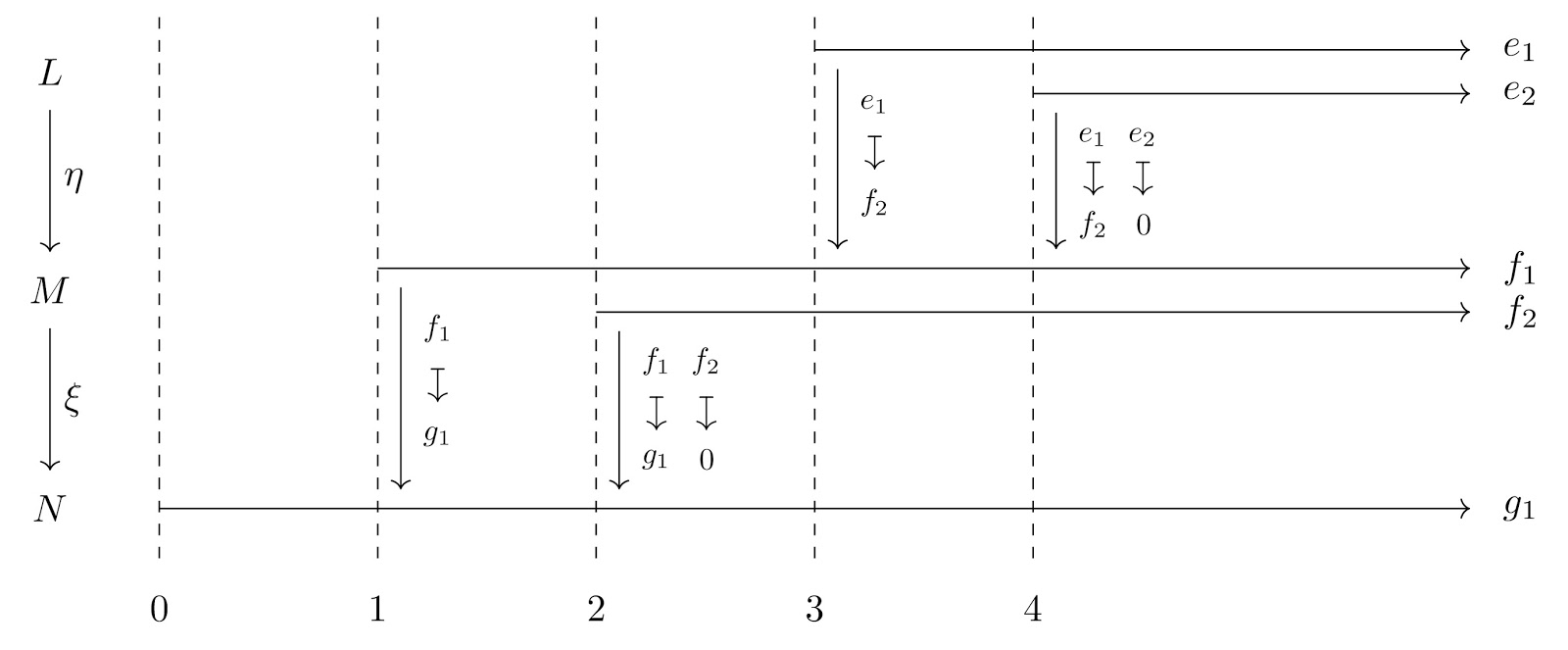
Example: The following example has a horizontal filtration with the degree 0 homology barcode on the left and the degree 1 homology barcode on the right. Linear maps of based vector spaces have also been shown to indicate how homology classes are born, die (column of zeros), and combine (row with more than one 1).
Example: Bauer and Lesnick present Example 5.6 to show that functoriality does not work in their setting. We reproduce their example and show that functoriality does work in our setting. Note that vertical ordering of the bars does not matter once they are named.
Apply the functor $\mathcal B$ to the whole diagram to get the matchings induced by $\eta$ and $\xi$, as below.
Next we hope to understand how interleavings fit into this setup.

References: Bauer and Lesnick (Induced matchings and the algebraic stability of persistence barcodes), Crawley-Boevey (Decomposition of pointwise finite-dimensional persistence modules)

Saturday, February 10, 2018

Artin gluing a sheaf 4: a single sheaf in two ways

The goal of this post is to give an alternative perspective on making a sheaf over $X = \Ran^{\leqslant n}(M)\times \R_{\geqslant 0}$, alternative to that of a previous post ("Artin gluing a sheaf 3: the Ran space," 2018-02-05). We will have one unique sheaf on all of $X$, valued either in simplicial complexes or simplicial sets.

Remark: Here we straddle the geometric category $SC$ of simplicial complexes and the algebraic category $\sSet$ of simplicial sets. There is a functor $[\ \cdot\ ]:SC\to \sSet$ for which every $n$-simplex in $S$ gets $(n+1)!$ elements in $[S]$, representing all the ways of ordering the vertices of $S$ (which we would like to view as unordered, to begin with).

Recall from previous posts:
  • maps $f:X\to SC$ and $g = [f]:X\to \sSet$,
  • the $SC_k$-stratification of $\Ran^k(M)\times \R_{\geqslant 0}$,
  • the point-counting stratification of $\Ran^{\leqslant n}(M)$,
  • the combined (via the product order) $SC_{\leqslant n}$-stratification of $\Ran^{\leqslant n}(M)\times \R_{\geqslant 0}$,
  • an induced (by the $SC_k$-stratification) cover by nested open sets $B_{k,1},\dots,B_{k,N_k}$ of $\Ran^k(M)\times \R_{\geqslant 0}$,
  • a corresponding induced total order $S_{k,1},\dots,S_{k,N_k}$ on $f(\Ran^k(M)\times \R_{\geqslant0})$.
The product order also induces a cover by nested opens of all of $X$ and a total order on $f(X)$ and $g(X)$. We call a path $\gamma:I\to X$ a descending path if $t_1<t_2\in I$ implies $h(\gamma(t_1))\geqslant h(\gamma(t_2))$ in any stratified space $h:X\to A$. Below, $h$ is either $f$ or $g$.

Lemma: A descending path $\gamma:I\to X$ induces a unique morphism $h(\gamma(0))\to h(\gamma(1))$.

Proof: Write $\gamma(0) = \{P_1,\dots,P_n\}$ and $\gamma(1) = \{Q_1,\dots,Q_m\}$, with $m\leqslant n$. Since the path is descending, points can only collide, not split. Hence $\gamma$ induces $n$ paths $\gamma_i:I\to M$ for $i=1,\dots,n$, with $\gamma_i$ the path based at $P_i$. This induces a map $h(\gamma(0))_0\to h(\gamma(1))_0$ on 0-cells (vertices or 0-objects), which completely defines a map $h(\gamma(0))\to h(\gamma(1))$ in the desired category. $\square$

Our sheaves will be defined using colimits. Fortunately, both $SC$ and $\sSet$ have (small) colimits. Finally, we also need an auxiliary function $\sigma:\Op(X)\to SC$ that finds the correct simplicial complex. Define it by \[ \sigma(U)  = \begin{cases}
S_{k,\ell} & \text{ if } U\neq\emptyset, \text{ for } k = \max\{1\leqslant k'\leqslant n\ :\ U\cap \Ran^k(M)\times \R_{\geqslant 0}\neq \emptyset\}, \\ & \hspace{2.23cm} \ell = \max\{1\leqslant \ell'\leqslant N_k\ :\ U \cap B_{k,\ell'}\neq\emptyset\},\\
* & \text{ if }U= \emptyset.
\end{cases} \]

Proposition 1: Let $\mathcal F$ be the function $\Op(X)^{op}\to SC$ on objects given by \[ \mathcal F(U) = \colim\left(\sigma(U)\rightrightarrows S\ :\ \text{every }\sigma(U)\to S \text{ is induced by a descending }\gamma:I\to U\right). \] This is a functor and satisfies the sheaf gluing conditions.

Proof: We have a well-defined function, so we have to describe the restriction maps and show gluing works. Since $V\subseteq U\subseteq X$, every $S$ in the directed system defining $\mathcal F(V)$ is contained in the directed system defining $\mathcal F(U)$. As there are maps $\sigma(V)\to \mathcal F(V)$ and $S\to \mathcal F(V)$, for every $S$ in the directed system of $V$, precomposing with any descending path we get maps $\sigma (U)\to \mathcal F(V)$ and $S\to \mathcal F(V)$, for every $S$ in the directed system of $U$. Then universality of the colimit gives us a unique map $\mathcal F(U)\to \mathcal F(V)$. Note that if there are no paths (decending or otherwise) from $U$ to $V$, then the colimit over an empty diagram still exists, it is just the initial object $\emptyset$ of $SC$.

To check the gluing condition, first note that every open $U\subseteq X$ must nontrivially intersect $\Ran^n(M)\times \R_{\geqslant 0}$, the top stratum (in the point-counting stratification). So for $W = U\cap V$, if we have $\alpha\in \mathcal F(U)$ and $\beta \in \mathcal F(V)$ such that $\alpha|_W = \beta|_W$ is a $k$-simplex, then $\alpha$ and $\beta$ must have been $k$-simplices as well. This is because a simplicial takes a simplex to a simplex, and we cannot collide points while remaining in the top stratum. Hence the pullback of $S\owns \alpha$ and $T\owns \beta$ via some induced maps (by descending paths) from $U$ to $W$ and $V$ to $W$, respectively, will restrict to the identity on the chosen $k$-simplex. Hence the gluing condition holds, and $\mathcal F$ is a sheaf. $\square$

Functoriality of $[\ \cdot\ ]$ allows us to extend the proof to build a sheaf valued in simplicial sets.

Proposition 2: Let $\mathcal G$ be the function $\Op(X)^{op}\to \sSet$ on objects given by \[ \mathcal G(U) = \colim\left([\sigma(U)]\rightrightarrows S\ :\ \text{every }[\sigma(U)]\to S \text{ is induced by a descending }\gamma:I\to U\right). \] This is a functor and satisfies the sheaf gluing conditions.

Remark: The sheaf $\mathcal G$ is non-trivial on more sets. For example, any path contained within one stratum of $X$ induces the identity map on simplicial sets (though not on simplicial complexes). Hence $\mathcal G$ is non-trivial on every open set contained within a single stratum.

References: nLab (article "Simplicial complexes"), n-category Cafe (post "Simplicial Sets vs. Simplicial Complexes," 2017-08-19)

Monday, February 5, 2018

Artin gluing a sheaf 3: the Ran space

The goal of this post is to extend earlier ideas, of a sheaf defined on $\Conf_n(M)\times \R_{\geqslant 0}$, to a family of sheaves defined on $\bigcup_{k=1}^n \Conf_n(M)\times \R_{\geqslant 0} = \Ran^{\leqslant n}(M)\times \R_{\geqslant 0}$.

Recall our main map $f:\Conf_n(M)\times \R_{\geqslant 0} \tov{VR(-)} SC_n \tov{\Hom(\Delta^\bullet,-)} \sSet$. Following Definition 1 and Proposition 2 in a previous post ("Artin gluing a sheaf 2: simplicial sets and configuration spaces," 2018-01-31), define a sheaf $\mathcal F_k$ on $X_k$ by \[ \mathcal F_k(U) = \begin{cases}
S_{k,\max\{1\leqslant \ell\leqslant N_k\ :\ U\cap B_{\ell}\neq \emptyset\}} & \text{ if $U$ is good,}\\
S_\emptyset & \text{ else if }U\neq\emptyset,
\end{cases} \hspace{2cm} (1) \] for all $k=1,\dots,n$. We have assumed a total order on all simplicial complexes on $k$ vertices, induced by a cover $U_k,\dots,U_{k,N_k}$ of nested opens of $X_k$. This induces a total order $S_{k,1},\dots,S_{k,N_k}$ on the image of $\Ran^k(M)\times \R_{\geqslant 0}$ in $\sSet$, and by the product order, a total order on all of $\sSet' := f(\Ran^{\leqslant n}(M)\times \R_{\geqslant 0})$.

A small example

Let $n=3$, so $X = \Ran^{\leqslant 3}(M)\times \R_{\geqslant 0}$. We already have $\mathcal F_1,\mathcal F_2,\mathcal F_3$ on $X_1,X_2,X_3$, respectively, and we will extend them from the top down to sheaves over all of $X$, as in the diagram below.
The map $i$ will be the inclusion of an open set into a larger one, and $j$ the inclusion of a closed set into a larger one. Recall that the pullback of two sheaves is defined equivalently by a map of sheaves on the boundary of the open nd closed sets. With that in mind, for $U\subseteq X_2\cup X_3$ good, the pullback square
defines $\mathcal F_{d_0}$, where the $d_0$ indicates the face map that skips the $0$th spot. The sheaf $\mathcal F_{d_1}$ is defined similarly, but by the face map $d_1$, and $\mathcal F_{d_2}$ by the face map $d_2$. For each of these three sheaves on $X_3\cup X_2$, we have two other sheaves, based on where the single point maps to. However, we note that for $U\subseteq X$ good and $U\cap X_1\neq\emptyset$, \[ \left((i_*\mathcal F_{d_0}\times j_*\mathcal F_1)(U) \text{ defined by } d_0\right)
\ \ =\ \
\left((i_*\mathcal F_{d_1}\times j_*\mathcal F_1)(U) \text{ defined by } d_0\right), \] where $\times$ denotes the pullback over the appropriate sheaf, and similarly for the other sheaves on good sets intersecting $X_1$. We now have 6 unique shaves on all of $X$.

Generalizing

Now let $n$ be any positive integer, and $X = \Ran^{\leqslant n}(M)\times \R_{\geqslant 0}$. We reverse the indexation of the $\mathcal F_k$ and $X_k$ above to make notation less cumbersome (so now $\mathcal F_k$ is $\mathcal F_{n-k+1}$ from (1), over $X_k = \Ran^{n-k+1}(M)\times \R_{\geqslant 0}$). Define pullback sheaves $\mathcal F_{d_{\ell_1}}$ for $\ell_1=0,\dots,n$ on $X_2\cup X_2$ by the diagram
At the $k$th step, for $1<k<n$, we have sheaves $\mathcal F_{d_{\ell_1}\cdots d_{\ell_{k-1}}}$ over $\bigcup_{m=1}^k X_m$, defined by sequences of face maps $d_{\ell_{k-1}}$ when going from $X_k$ to $X_{k-1}$ and so on, where $\ell_m\in \{0,\dots,n-m+1\}$. Define pullback sheaves $\mathcal F_{d_{\ell_1}\cdots d_{\ell_{k-1}}d_{\ell_k}}$, for $\ell_k = 0,\dots,n-k+1$ on $\bigcup_{m=1}^{k+1} X_k$ by the diagram
At the end of this inductive process, we have $n!$ distinct sheaves $\mathcal F_{d_{\ell_1}\cdots d_{\ell_{n-1}}}$ on all of $X$. Note there is a sheaf map $\mathcal F_{d_{\ell_1}\cdots d_{\ell_i}\cdots d_{\ell_{n-1}}} \to \mathcal F_{d_{\ell_1}\cdots d_{\ell_i'}\cdots d_{\ell_{n-1}}}$, given on $U$ good by \[ \mathcal F_{d_{\ell_1}\cdots d_{\ell_i}\cdots d_{\ell_{n-1}}}(U) = S \mapsto \begin{cases}
S & \text{ if } |S_0| \leqslant n-i, \\
(\ell_i\ \ell_i')(S) & \text{ else,}
\end{cases} \] where $(\ell_i\ \ell_i')\in \mathfrak S_n$ (the symmetric group on the numbers $0,\dots,n-1$) is the transposition swaps the $\ell_i$ and $\ell_i'$ indices of $S_0$, the 0-cells of $S$, inducing a map of simplicial sets. If the two sheaves differ in only two indices $\ell_i\neq \ell_i'$ and $\ell_j\neq \ell_j'$, with $i<j$, then we get $S\mapsto (\ell_j\ \ell_j')_{d_{\ell_{i-1}} \cdots d_{\ell_j}}(\ell_i\ \ell_i')(S)$. Here $(\ell_j\ \ell_j')_{d_{\ell_{i-1}} \cdots d_{\ell_j}}$ is the element of $\mathfrak S_{n-i}$ found by taking $(\ell_j\ \ell_j')$ from $\mathfrak S_{n-j}$ to $\mathfrak S_{n-i}$ by the sequence of group inclusion maps induced by the face maps $d_{\ell_j},\dots,d_{\ell_{i-1}}$.

Remark: This construction is not the most satisfying, for several reasons:
  • we do not have a single sheaf, rather a family of sheaves, and
  • the use of "good" sets leaves something to be desired, as we should be able to consider larger sets.
Both will hopefully be remedied in a later post.